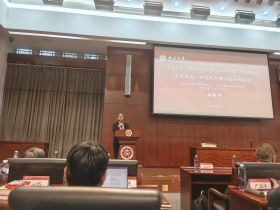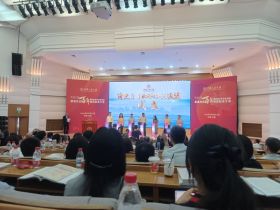


On October 18th, Brother Chen Tuo from Nankai University's School of History organized a workshop. Young scholars are full of energy and offered direct critiques. I extend my gratitude to commentators Professor Zhu and Brother Chen for raising many excellent questions—the session proved highly fruitful.
From the 19th to the 24th, Professor Hsia delivered a series of lectures at Nankai and Beijing.
On the afternoon of the 20th at Peking University, over 20 attendees gathered—a turnout exceeding expectations. Among them were five from the Central Academy of Socialism, one from Hangzhou, one from neighboring Tsinghua University, one from the Chinese Department, and five doctoral students in our discipline. Notably, no undergraduates from our department were present.
Professor Hsia introduced the core content of his new work.
1. A combination of chronicle and thematic research.
2. Covers all cutting-edge topics: history of imagery, history of books, history of mentalities, gender history, sacred dreams, folk religion, catechisms, ritual controversies, church incidents and Qing politics, etc.
3. Utilized archival materials, such as missionary correspondence, to reveal specific details:
(1) While Zhaoqing hosted a Matteo Ricci exhibition, organizers were unaware of his attire in Zhaoqing and merely displayed an image of Jesus. In reality, Ricci wore monk's robes during his time there.
(2) This monk's attire subjected him to frequent discrimination, fostering resentment toward Buddhism. His work True Meaning of the Lord Jesus Christ launched a fierce critique of Buddhism.
(3) Matteo Ricci had read the Lotus Sutra, yet missionaries misunderstood Buddhism, interpreting “Namo Amitabha” as “Southern Amitabha Buddha.”
(4) During the Yongzheng era, correspondence between Jesuit and Franciscan missionaries in Shandong mentioned a local believer arrested, beaten for lack of ransom money, and dying after returning home. His wife placed his portrait alongside an image of Jesus for worship, declaring that Jesus died to save the Great Qin while her husband died to save the Chinese people. She proclaimed her husband to be Jesus's brother in China, gathering a following. The missionaries debated how to handle this, but to avoid official scrutiny or the spread of this scandal, the matter was quietly dropped.
(5) During the Kangxi Rites Controversy, the Emperor was deeply troubled by the Nine Princes' Struggle for the Throne. Yan Dang's inability to recite scriptures led Kangxi to view Jesuits as their “baiyi” servants, believing that “a dog must obey its master.” (Nian Gengyao's use of “subject” instead of “servant” was deemed disloyal.)
4. History and philosophy differ fundamentally; ideological content is scarcely discussed, though one chapter addresses terminology translation issues.