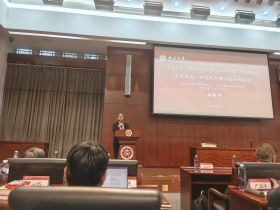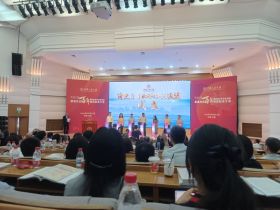


The content was excellent, and the discussion among the professors was very in-depth.
I responded to Professor Lin’s remarks by addressing five main points:
1. It may be too sweeping to claim that the Jesuits opposed Song-Ming Neo-Confucianism for 150 years; (Professor Lin noted that this was a view expressed by Chen Shouyi.)
2. Huang Zongxi’s criticism of Catholicism was not unique; at the time, Liu Zongzhou, Qian Qianyi, Dong Han, and others were also opposing it. Huang Zongxi was relatively moderate. In 1692, Emperor Kangxi issued the “Edict on Tolerance of Religion,” and in 1694, Huang Zongxi published his “Treatise on Refuting Heresy.” In reality, the literati were deeply dissatisfied. Emperor Yongzheng later remarked that Kangxi’s favorable treatment of Catholicism caused his standing among the literati to plummet.
Qian Qianyi: Opposed Catholicism and Western learning; Huang Zongxi: Opposed Catholicism but absorbed Western learning.
“Adopting the tools while rejecting the principles” became the mindset of most literati.
3. Huang Zongxi’s criticism of Catholicism must be understood in the context of his opposition to Buddhism and folk religions; it was not directed solely at Catholicism, unlike that of other anti-Catholic literati.
4. Professor Lin pointed out that it was not Matteo Ricci who constructed Confucian monotheism, but rather the literati. I believe these works were, in fact, collective endeavors; the literati also contributed to Ricci’s writings and ideas.
5. Professor Lin noted that there were two versions of the “Emperor-Heaven” theory in the late Ming period, but I believe there was only one. Matteo Ricci’s “Emperor-Heaven” theory was merely an appropriation that was later abandoned by the Church.
Translated with DeepL.com (free version)