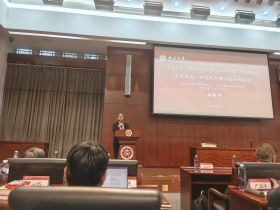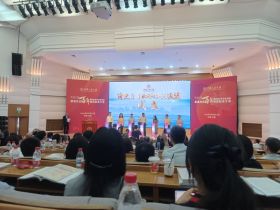


On the morning of March 17, 2026, the Center for Christian Studies at the Chinese Academy of Social Sciences and the Department of Christian Studies at the Institute of World Religions held an academic lecture titled “An Examination of ‘Secularism’: Focusing on Chinese Christian Texts from the Ming and Qing Dynasties” in the main conference room. The lecture featured Xiao Qinghe, Tenured Associate Professor in the Department of Philosophy at Peking University, as the keynote speaker. It was moderated by Yang Huaming, Associate Research Fellow and Deputy Director of the Department of Christian Studies at the Institute of World Religions, with Zhou Weichi, Liu Guopeng, and Li Huawei—all Research Fellows at the Institute of World Religions—serving as discussants.
At the beginning of the lecture, Zheng Xiaoyun, Director of the Institute of World Religions, delivered the opening remarks. Researcher Zheng Xiaoyun extended her congratulations on the event and welcomed and thanked Professor Xiao Qinghe and the attending scholars. She noted that this lecture highlighted the deep friendship and close collaboration between Peking University and the Institute of World Religions, and that the topic, closely tied to the Sinicization of Christianity and the exchange and mutual learning among human civilizations, held outstanding theoretical value and academic significance. Zhuo Xinping, Member of the Academic Division of the Chinese Academy of Social Sciences, delivered an academic address. He reviewed the long-standing and inseparable academic ties between Peking University and the Institute of World Religions, affirmed Professor Xiao Qinghe’s research perspective, and advocated for the construction of an autonomous Chinese religious studies knowledge system grounded in indigenous sources.
Professor Xiao Qinghe examined the semantic evolution of “the secular”—a core concept in Ming and Qing Christianity—within the framework of civilizational exchange and mutual learning. He first traced the semantic evolution of the concept of “secular” within the traditional Chinese context, as well as the views and practices of Song and Ming Confucian literati in criticizing the secular world. He then analyzed the Western Catholic intellectual tradition’s conception and characteristics of “the secular” (this world; saeculum mundi), particularly examining Augustine and Aquinas’s critiques of pagan customs. Employing a methodological framework of Sino-Western cultural interaction, he centered his analysis on the Chinese-language Christian writings of Ming and Qing missionaries such as Matteo Ricci and Giulio Aleni, examining the doctrine of the “Three Enemies” and the ascetic characteristics therein. He argued that the missionaries introduced Western concepts of the “world” and the “secular” into China, thereby transforming traditional Chinese perspectives. Finally, he briefly outlined the differing reactions to the Catholic view of the secular world among pro- and anti-Catholic figures in Ming and Qing society.
During the discussion session, Researcher Zhou Weichi supplemented the lecture’s themes by examining the topic from the perspectives of Christian “ethics of the two worlds,” missionaries’ views and strategies regarding the virtues and customs of non-Christians, and the relationship between religion and civilization. Researcher Liu Guopeng raised points for discussion regarding the Western translation of “secular” and its Japanese origins, the distinction between customs within and outside the Church, and the differing perspectives of local missionaries. Researcher Li Huwei further explored the definition of the concept of “secular” in terms of its connotations and denotations, as well as the dichotomy and correspondence between “sacred” and “secular.”
During the session, Professor Wu Gongqing from Renmin University of China and Associate Researcher Huang Ying from the Institute of World Religions engaged in discussions with Professor Xiao Qinghe regarding the tension between the sacred and the secular within Catholicism itself, the Jesuits’ shifting attitudes toward non-Christian cultures, and how Ming and Qing dynasty literati and missionaries debated questions of this-worldliness. The lecture concluded successfully in a lively and dynamic atmosphere.
More: http://iwr.cass.cn/qt/xsdt/xw/202603/t20260319_5977375.shtml